
Is surveillance legal? Is it necessary for security? What is the balance between the freedoms of the people to their own privacy versus that of their protection?
May I present to you the controversial figure that is Edward Snowden:
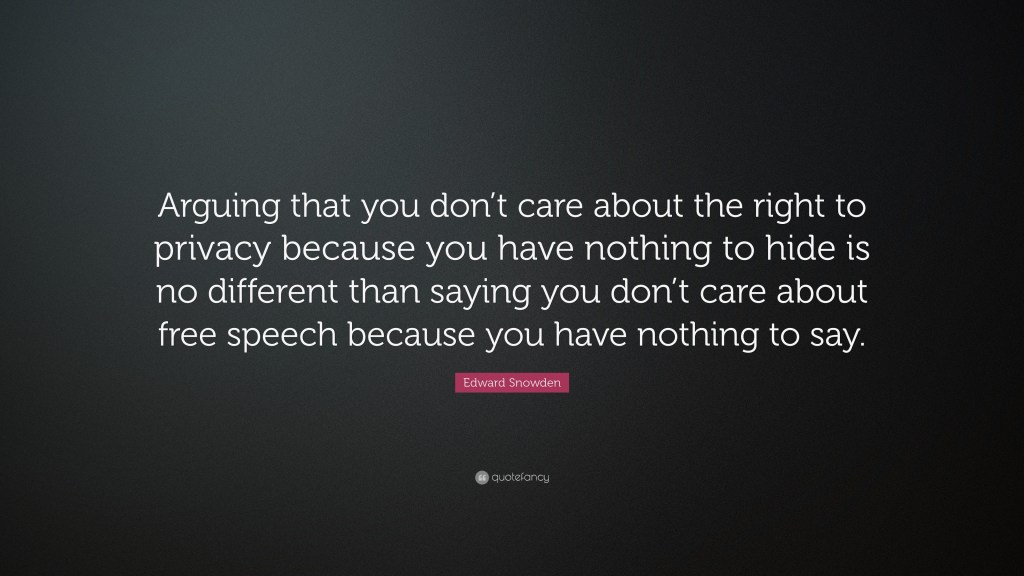
Some say he is a traitor. Others say he is a patriot. I’ll state the case, share some of my own thoughts, and then let you decide for yourself.
An employee of the CIA (Central Intelligence Agency) and NSA (National Security Agency), Snowden was responsible for both helping to create and helping to expose the U.S. government’s secret mass surveillance programs. He copied and leaked classified documents, providing them to journalists. Snowden attributes the natural rise of such technology to the aftermath of September 11th, 2001, when the World Trade Center was destroyed by terrorists and the Intelligence Community was left wondering how it happened on their watch and what could be done to prevent it from happening again. Instead of using the threat to U.S. security as an opportunity to strengthen values and resolve to life and liberty, fear led to the War on Terror and what some may consider amoral actions through breach of privacy and freedom in the name of protection.
An example of this can be found in Section 215 of the USA PATRIOT Act (Uniting and Strengthening America by Providing Appropriate Tools Required to Intercept and Obstruct Terrorism Act). Section 215 gave the government permission to request business records for an individual believed to be involved in terrorism. Documents Edward Snowden leaked revealed that the government was using Article 215 as justification for a mass collection of phone records including the identities of those on the call, when the call was placed, and how long the call lasted. This article expired in 2015 but the PATRIOT Act was then replaced with the FREEDOM Act which altered some of the PATRIOT Act to enhance restrictions on surveillance.
If the United States keeps data on their own citizens, what makes them any different from the German secret police during WWII or the current government dictatorship in China?
I would argue it doesn’t. The price of freedom should not be so high as to restrict citizens’ personal freedoms and right to privacy. To what extend is an action justifiable in order to achieving it’s goal? Like most moral predicaments, there is not a quick and easy answer that can be applied to all situations. Nevertheless, do I believe a balance can be found between security and privacy? Yes. There is a reason for checks and balances in government, which provides separation of power. There are also audits, which consist of internal investigations by an independent party. And of course there is data encryption.
That isn’t to say that the Intelligence Community (IC) doesn’t have any rights to secrecy. By some token, it is in the very nature of their job description and secrecy is at times necessary to maintaining our national security. But as Edward Snowden expressed, and I agree, they should be held more accountable to their own actions when it relates to the privacy of citizens.
In the aftermath of his alleged crimes, Snowden found asylum in Russia where he now resides with his wife and is the president of Freedom of the Press Foundation, a nonprofit organization which “protects, defends, and empowers public-interest journalism in the 21st century.” In September of 2019, Snowden released a memoir entitled, “Permanent Record,” which catalogs the story from his own experience and perspective. I’ve picked up a copy at the library and look forward to reading it. Perhaps I’ll make another blog post after I’ve finished it and can give a review.
(For the full story, please read “Privacy and Security Part 2: An Accurate Account…)
“Then you will know the truth, and the truth will set you free.” – John 8:32

 Unwind_My_Mind